Where this advice comes from
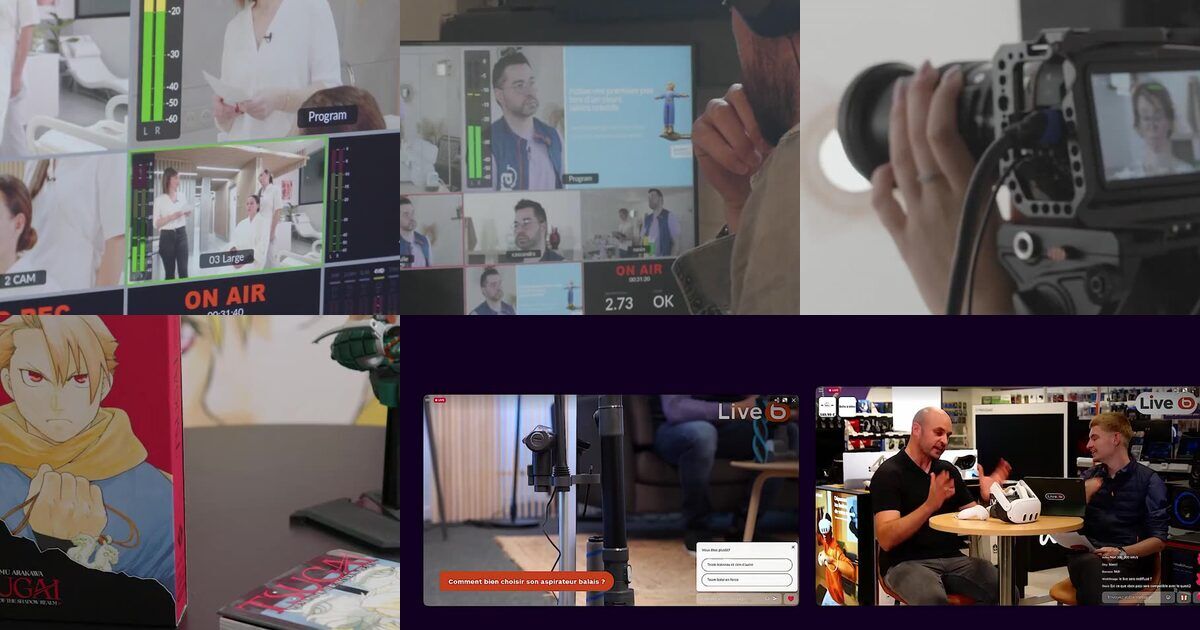
There is no shortage of advice on live shopping. This advice comes from the people who do it: fifteen professionals at Boulanger, Cultura, Petit Bateau, E.Leclerc, Pierre Fabre and Cricut, interviewed on camera. Each quote below is translated from the transcript of their interview, in French, which you can watch in full in the Caast video hub. Antoine Leclercq described its launch in Live shopping, told by the people who do it.
Eight lessons emerge, from the reason for getting started to the life of the replay on product pages.
1. Live gives what the product page cannot
"It is a moment when we can really interact, because it is true that on the website, you cannot put everything. Customers go very fast, they look at the information very fast."
Karine Attali, E-Retail Manager at Petit Bateau (watch the interview)
Elodie Zittoun, e-commerce site officer at E.Leclerc, sees it first as a decision aid: "it lets you get more information about a product, and really ask yourself: do I want to buy it? Why?" (watch the interview).
At Cultura, direct access was the deciding factor: "it is a format that can be easily viewed on the Cultura website. You can ask questions in a chat, you can click on product clips as soon as we present something," explains Adrien Ruiz, content project manager (watch the interview).
Key takeaway: a live is first of all a way to answer the questions the product page leaves open.
2. Anything but home shopping
Three companies say it, each in their own words. Karine Attali, at Petit Bateau: "The idea is not to do home shopping, so to speak, saying 'everything is 50% off, everything is 30% off'. That is not at all where we want to go." (watch the interview)
Cassandra Godbillot, content project officer at Cultura, gives the retailer's recipe: "do something ultra interactive, and not slip into the codes of home shopping, of television" (watch the interview).
And Paul Meheu, who hosts Boulanger's lives:
"The idea is also to tell a story that you do not get on the product poster. It is real added value, and it is what customers expect."
Paul Meheu, New Content Creation Lead at Boulanger (watch the interview)
Key takeaway: you demonstrate, you tell stories, you get people involved. Discounts are not what the live is about.
3. People first, and preferably the same person
Adrien Ruiz's advice for getting started fits in one sentence: "put people first", ending with: "So really: people, people, people." (watch the interview)
Petit Bateau has some of its lives hosted by its own teams. "We do a lot of lives with the Petit Bateau teams, because we also like showing our customers what goes on behind the scenes," says Karine Attali (watch the interview). Fanny Bernier, the brand's e-commerce manager, bears this out: "For me, it is not my job, but it is a pleasure." (watch the interview)
At Boulanger, what matters is having the same host every time, also an employee.
"When you have someone and you are used to it, and you organize yourselves every week, it is easy to go and test new things, which you cannot afford when you change host and structure every week."
Pauline Roche, New Content Project Manager at Boulanger (watch the interview)
Key takeaway: faces who know the products, and a regular host so you can test new formats without rebuilding everything.
4. Preparing: from three weeks to three months
Frédéric Faitfeu, service manager at Pierre Fabre, splits each live into three phases: "a pre-live part, which we call 'build', where we think about the whole strategy of the live", then the live itself, then "a post-live part, where we analyze the performance and the impact of the live" (watch the interview).
The lead time depends on the pace and scale of the live:
| Situation mentioned | Preparation time | Source |
|---|---|---|
| One live a week, at Boulanger | "three, four weeks ahead" | Clémence Lechevalier, Live Shopping Project Manager |
| A live organized with a brand, at Cultura | "two and a half, three months" | Cassandra Godbillot, content project officer |
| The script, once the outline is well established | "two hours if you really sit down to it" | Cassandra Godbillot |
What saves that time, according to Cassandra Godbillot: "we have a sort of skeleton for our lives: we know the parts, we know how we are going to interact, we always have ideas for activities".
For those whose job is not hosting, preparation focuses on the product. Fanny Bernier: "All I look at is really the nature of the product, so I do not tell the customer anything wrong" (watch the interview). Sébastien Simonetta, category officer at E.Leclerc, on his first live: "I prepared from a script, I made summary points so that it would be a bit easier to remember." (watch the interview)
Key takeaway: an outline reused from one live to the next, and preparation centered on the products, not on a text learned by heart.
5. Bringing in the audience: owned channels, brand and influence
Adrien Ruiz details Cultura's setup: "mentions in newsletters, banners that appear on our category pages, communication launched on social networks, Instagram, Facebook". Then: "we also work with the brand we are creating the live with, and with an influencer, precisely to speak up and tease the live" (watch the interview).
Key takeaway: the audience is built before the live, with the retailer's channels, those of the guest brand and an outside voice.
6. Moderation, the invisible half of the live
Agathe Philippeau, senior community manager at Cultura, describes the split of roles: "there are questions we will answer directly in the chat, but questions we will pass on to the live set" (watch the interview).
"The moderator identifies an interesting question and pushes it into a private space that the speakers on set can see. They read the question automatically on a tablet."
Adrien Ruiz, Content Project Manager at Cultura (watch the interview)
At Boulanger, this sorting also makes improvisation possible. Paul Meheu: "the moderation team, to make my job a bit easier, because sometimes there are a lot of them, selects the most relevant ones for me". And when he throws out a question on the fly, "So, are you team robot vacuum or team stick vacuum?", the poll appears in the chat right away (watch the interview).
Key takeaway: plan for dedicated moderation, which answers in the chat and passes on to the set the questions that are useful to everyone.
7. Lasting: renewing, then professionalizing
A weekly show only holds up if it changes every week. Romain Keirle, new content manager at Boulanger: "you can come one week, and the week after, it is not the same, it is not the same thing" (watch the interview).
Cultura, for its part, has grown its resources over time: "At first, we did it in a fairly homemade way, with one camera, one speaker, a small set." Then came "a studio dedicated to it, a custom set every time and a technical crew" (watch the interview).
Pierre Fabre chose to leave the studio for one live: Florence Grasser, consumer experience and point-of-sale activation director, wanted "to be able to have several zooms, and much more dynamic than the static setup we are used to" (watch the interview).
Key takeaway: start simple, then invest in the set and the production once the show is established.
8. After the live, the replay works on the product pages
"The replay is essential: it enriches our product pages, and so it informs our consumers about the product's strengths."
Fabien Blot, Channel Marketing Manager at Cricut (watch the interview)
Thomas Gentillet, KAM eRetail & Marketplaces at Pierre Fabre, describes the mechanism at the e-retailers that broadcast the brand's lives: "at the end of each live, the live is automatically cut into short product segments and attached to the product pages of our e-retailers' sites" (watch the interview).
Paul Meheu puts it this way for Boulanger: "Live shopping is great content, but afterwards you have to reuse it, that is, put it on the right customer journey at the right moment."
Key takeaway: the live passes, its clips stay on the product pages. That is the principle of shoppable video and of the shoppable replay.
What the 15 testimonials have in common
- Answering questions, without reciting the product page.
- People who know the products, often employees, in a tone far from home shopping.
- A stable method: before, during, after, with a reused script skeleton.
- Dedicated moderation that connects the chat to the set.
- A replay cut into clips and put back on the product pages.
To go further: the Boulanger, Petit Bateau, Pierre Fabre and E.Leclerc case studies, all the interviews in the video hub, and the simulator to build your own live plan.
Frequently asked questions
How long does it take to prepare a live shopping event? At Boulanger, which runs one live a week, preparation starts three to four weeks ahead. At Cultura, a live organized with a brand takes two and a half to three months, and the script about two hours once the outline is well established.
Who should host a live shopping event? People who know the products, often employees. Petit Bateau has some of its lives hosted by its own teams, and Boulanger keeps the same host so it can test new formats.
What is moderation for during a live? It answers some questions directly in the chat and passes on to the set the ones that are useful to everyone. At Cultura, the speakers read them on a tablet.
What happens to the live after it airs? The replay enriches the product pages. At the e-retailers that broadcast Pierre Fabre's lives, the live is automatically cut into short product segments, attached to the product pages.
Ready to launch your Live Commerce strategy?
Discover how Caast can help you with a personalized demo.
Book a meeting